Theory & Methods
When to read this page
Read this page after completing the Tutorial. It explains the scientific methods behind q2mm's pipeline — why each stage exists and what the math is doing. For practical "which optimizer should I use?" guidance, see the Optimization Guide.
Key terms used on this page:
| Term | Meaning |
|---|---|
| Hessian | Matrix of second derivatives of energy with respect to atomic positions — encodes how stiff each bond and angle is |
| QFUERZA | Q2MM's method for extracting initial force constants from the QM Hessian without iterative fitting |
| Eigenvalue | A number from the Hessian eigendecomposition; each eigenvalue corresponds to a vibrational mode's stiffness |
| Objective function | A single number measuring how poorly the current force field reproduces the QM reference data — the optimizer minimizes this |
| Grad-simp | Q2MM's optimization strategy: alternate gradient-based and simplex refinement passes |
| RMSD | Root-mean-square deviation — average error between QM and MM values |
| R² | Coefficient of determination — 1.0 means perfect agreement, 0.0 means no correlation, negative means worse than the mean |
For the generic observation recipe, rigid-mode accounting and the distinct repository compatibility profile used by publication case loaders, see Fitting objectives and reference data.
The pipeline at a glance
Q2MM converts quantum mechanical (QM) reference data into molecular mechanics (MM) force field parameters through a multi-stage pipeline:
flowchart LR
    A["QM Hessian"] --> B["QFUERZA\nestimation"]
    B --> C["Initial\nparameters"]
    C --> D["Objective\nfunction"]
    D --> E["Grad-simp\noptimization"]
E --> F["Refined\nforce field"]- QFUERZA estimation extracts initial force constants from the QM Hessian — a physically informed starting point
- Eigenvalue treatment handles the negative eigenvalue present in transition state Hessians by inverting the curvature
- Objective function measures how well MM-computed observables (energies, frequencies, geometries) match QM reference data
- Grad-simp optimization refines parameters by alternating gradient-based and simplex methods
Each stage is described in detail below.
Stage 1: QFUERZA estimation
Q2MM estimates initial force constants from a quantum mechanical Hessian using Seminario projection (Seminario, Int. J. Quantum Chem. 1996, 60, 1271) with QFUERZA post-processing (Farrugia et al., J. Chem. Theory Comput. 2025, 22, 469–476, DOI:10.1021/acs.jctc.5c01751). For each internal coordinate (bond or angle), the method:
- Extracts the 3×3 Cartesian sub-block of the Hessian for the relevant atoms
- Eigendecomposes the sub-block
- Projects each eigenvector onto the bond or angle direction
- Sums the projected eigenvalues, weighted by the alignment of each eigenvector with the internal coordinate
- For hydrogen angle bends, substitutes the empirical default (0.5 mdyn·Å/rad²) because Seminario projection overestimates these by ~2×
flowchart LR
    A["QM Hessian\n(3N × 3N)"] --> B["Extract\nsub-block"]
    B --> C["Eigendecompose\nsub-block"]
    C --> D["Project onto\nbond/angle"]
    D --> E["Sum weighted\neigenvalues"]
    E --> F["Initial force\nconstant k₀"]
The result is a set of initial force constants that reflect the QM potential energy surface curvature at that geometry. These are much better starting points than default values from a generic force field — they put the optimizer in the right region of parameter space from the start.
Seminario vs QFUERZA
Seminario projection works well for bonds but overestimates hydrogen angle bend force constants by roughly 2×. QFUERZA fixes this by substituting the empirical default (0.5 mdyn·Å/rad²) for any angle where either outer atom is hydrogen. For non-hydrogen angles and all bonds, QFUERZA and plain Seminario give identical results.
QFUERZA is the default. To use plain Seminario projection instead:
from q2mm.models.forcefield import FunctionalForm
from q2mm.models.seminario import qfuerza_fresh

# Default — QFUERZA (recommended). functional_form is required — no
# default is chosen for you; pick HARMONIC for JAX/JAX-MD or MM3 for
# OpenMM/Tinker.
ff = qfuerza_fresh(molecule, functional_form=FunctionalForm.HARMONIC)

# Plain Seminario projection (no H-angle substitution)
ff = qfuerza_fresh(molecule, functional_form=FunctionalForm.HARMONIC, strategy="fuerza")
The implementation lives in
q2mm.models.seminario.
Stage 2: transition state eigenvalue treatment
At a ground-state minimum, physical vibrational curvatures are positive; ideal rigid motions have zero curvature. Approximate stationary geometries can also carry small residual rotational curvature. Transition states (TSs) are different: they have exactly one negative eigenvalue in their Hessian, corresponding to the reaction coordinate.
This creates a fundamental tension. MM force fields represent TSs as energy minima — physical vibrational curvatures must be positive. How do you fit MM parameters to a QM Hessian that has a negative eigenvalue the MM model can't reproduce?
Limé & Norrby (J. Comput. Chem. 2014, 36, 244–250; 2015 issue, DOI:10.1002/jcc.23797) systematically tested five methods for handling this, labeled A through E. These methods address two independent choices: what data to fit (A vs B) and how to treat the negative eigenvalue (C, D, or E).
What data to fit: Methods A and B
Methods A and B differ in which Hessian elements are included in the objective function.
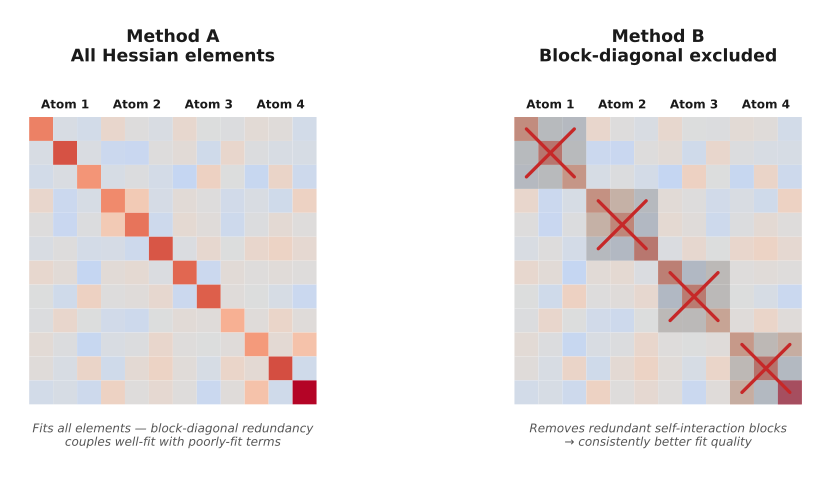
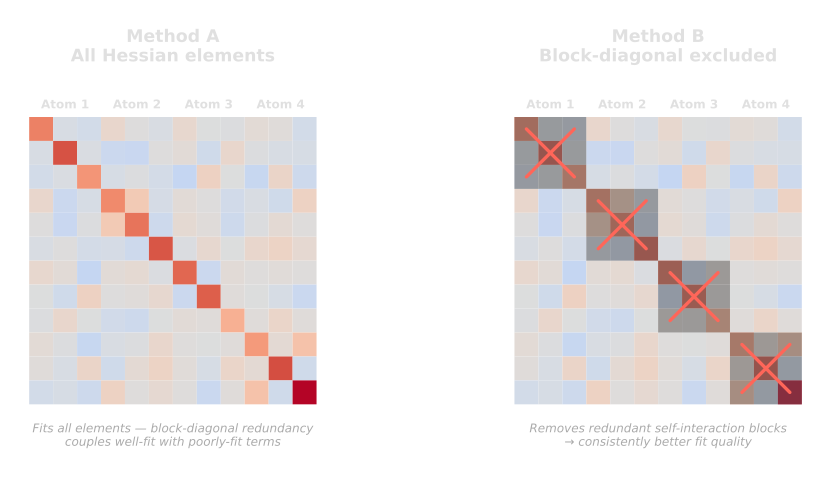
Method A ("original Hessian fitting") fits to all elements of the Cartesian Hessian, using bond-distance-based weighting to distinguish stretches, bends, torsions, and long-range interactions.
Method B ("off-diagonal Hessian fitting") excludes block-diagonal elements — the 3×3 blocks where both coordinates belong to the same atom. These are redundant (they're sums of off-diagonal elements) and including them couples well-fit elements with elements that can't be represented by the available MM functions. Removing them consistently improves the fit.
Note
Methods A and B are about objective function design, not eigenvalue
treatment. They're orthogonal to the TS curvature handling below. Q2MM's
evaluator system (see Data Types) addresses this
same design space through HessianElementEvaluator and
EigenmatrixEvaluator.
How to treat the TS eigenvalue
A transition-state Hessian has one negative eigenvalue — the reaction coordinate. This is physically correct (saddle point), but Seminario projection needs all-positive eigenvalues to produce valid force constants.
Q2MM supports curvature inversion: decompose the Hessian, replace the negative eigenvalue with a large positive value (1.0 Hartree/Bohr²), and reconstruct. This is based on Limé & Norrby's eigenvalue replacement approach (J. Comput. Chem. 2014, vol. 36, 244–250, published 2015).
What Q2MM implements
| Function | Module | Purpose |
|---|---|---|
invert_ts_curvature() |
q2mm.models.hessian |
Decompose → replace negative eigenvalue → reconstruct |
replace_neg_eigenvalue() |
q2mm.models.hessian |
Low-level eigenvalue replacement |
The invert_ts_curvature parameter on both qfuerza_fresh() and
qfuerza_into() controls whether curvature inversion is applied
(default: False; published-FF system loaders pass True for TS systems).
Functional forms
The force field's functional form determines the energy expression used for each interaction type:
| Form | Bond Energy | Angle Energy | vdW |
|---|---|---|---|
HARMONIC |
k(r − r₀)² | k(θ − θ₀)² | Lennard-Jones 12-6 |
MM3 |
k(r − r₀)²[1 − 2.55Δ + …] | k(θ − θ₀)²[1 − 0.014Δ + …] | Buckingham exp-6 |
The functional form is set when loading a force field and validated at every boundary:
- Loaders set
forcefield.functional_formbased on the source format. - Savers reject incompatible forms — e.g., an AMBER frcmod saver rejects an MM3-form force field.
- Backends validate compatibility before creating a prepared session.
This prevents silent mismatches where MM3 cubic/sextic constants would be interpreted as harmonic spring constants. The functional form is carried through the entire pipeline from load to save.
Stage 3: the objective function
With initial parameters in hand, Q2MM needs a way to measure how good a force field is. The objective function computes:
where \(x_{\text{ref},i}\) is a QM reference value, \(x_{\text{calc},i}\) is the corresponding MM-computed value, and \(w_i\) multiplies the residual before squaring. This is the data term; optional regularization is separate.
Each evaluation runs the MM backend (OpenMM, Tinker, JAX, or JAX-MD) with the current parameters, computes the requested observables, and compares them to the QM reference. The types of observables that can be included are:
| Observable | Evaluator | What it measures |
|---|---|---|
| Energy | EnergyEvaluator |
Relative conformational energies |
| Frequency | FrequencyEvaluator |
Vibrational frequencies (cm⁻¹) |
| Geometry | GeometryEvaluator |
Bond lengths, angles, torsions |
| Hessian elements | HessianElementEvaluator |
Individual Hessian matrix entries (Methods A/B) |
| Eigenmatrix | EigenmatrixEvaluator |
Eigenmode-projected Hessian (Methods C/D/E) |
Weights control the balance between observable types. Getting the weighting right is important — for example, giving too much weight to energies can produce a force field with good relative energies but poor geometries.
The implementation lives in
q2mm.objectives.
Stage 4: optimization
Why not just use QFUERZA estimates directly?
QFUERZA parameters capture the local curvature of the QM potential energy surface at each input geometry. When multiple molecules or conformers are provided, the estimates are averaged across all of them — but each estimate still reflects curvature at a single point. The resulting force constants are good initial guesses, but a force field also needs to reproduce energies, gradients, and torsional profiles across the full conformational landscape. The initial estimates need refinement to balance all of these targets.
Gradient-based optimization
The first pass uses a gradient-based optimizer (L-BFGS-B by default) over all parameters simultaneously. This efficiently descends the smooth parts of the objective landscape, handling parameter bounds naturally. For backends that support analytical gradients (JAX, JAX-MD), this step benefits from automatic differentiation — no finite differences needed.
Simplex optimization
Some parameters have steep but shallow-bottomed objective landscapes — the first derivative is large, but the second derivative is small. Gradient-based methods like L-BFGS-B struggle here because the finite-difference gradient estimate can overshoot, causing the optimizer to oscillate rather than converge. The Nelder-Mead simplex method doesn't use gradients at all; it evaluates the objective at a simplex of points and reshapes the simplex to find the minimum, making it robust for these parameters.
The downside: simplex scales poorly with dimensionality. Running it on all parameters at once is impractical for large force fields. This is where sensitivity analysis comes in.
Grad-simp cycling
The grad-simp loop combines the strengths of both methods:
flowchart TD
    A["Gradient\noptimization\n(all params)"] --> B["Sensitivity\nanalysis"]
    B --> C{"Rank params\nby sensitivity"}
    C --> D["Select least\ngradient-suitable"]
    D --> E["Simplex\noptimization\n(subset only)"]
    E --> F{"Converged?"}
    F -- No --> A
    F -- Yes --> G["Final\nforce field"]
Each cycle:
- Full-space gradient pass — L-BFGS-B over all parameters
- Sensitivity analysis — rank parameters by simplex suitability
- Subspace simplex pass — Nelder-Mead on the parameters where gradient
methods struggle most (default: bottom 3 by
simp_var) - Convergence check — stop when improvement drops below threshold
For each parameter, central finite differences estimate the first and second derivatives:
d1 = (f(x+h) - f(x-h)) / (2h)        # first derivative
d2 = (f(x+h) - 2f(x) + f(x-h)) / h²  # second derivative
Parameters are ranked by simp_var = d2 / d1². Low simp_var identifies
parameters where the objective is steep but shallow-bottomed — gradient
methods struggle here, but simplex can make progress. The parameters with
the lowest simp_var are selected for the simplex pass.
The implementation lives in
q2mm.optimizers.cycling.
Numerical safety
Several numerical issues can arise during optimization. Q2MM includes safety layers that handle them automatically.
Eigendecomposition robustness
Converting a Hessian matrix to vibrational frequencies requires eigendecomposition: \(H = X^T \Lambda X\), where \(\Lambda\) contains the eigenvalues and \(X\) the eigenvectors. In practice:
Asymmetric Hessians. By Schwarz's theorem, the Hessian of
any twice continuously differentiable function is symmetric:
\(\partial^2 f / \partial x_i \partial x_j = \partial^2 f / \partial x_j \partial x_i\).
In exact arithmetic this always holds for potential energy surfaces.
However, analytical autodiff frameworks (e.g., jax.hessian) compute the
two mixed partials via different chains of elementary operations — forward-
over-reverse or reverse-over-forward — and floating-point rounding at each
step can differ. The result is a Hessian that is only approximately
symmetric, with off-diagonal discrepancies on the order of machine epsilon
(\(\sim 10^{-15}\) in float64, \(\sim 10^{-7}\) in float32). This is a
known property of JAX's Hessian computation.
LAPACK's dsyevd (used by numpy.linalg.eigvalsh) assumes exact
symmetry and can crash with "Eigenvalues did not converge" when it
encounters asymmetric entries. Q2MM guards against this by symmetrizing
unconditionally before decomposition:
This is the standard remedy in numerical linear algebra — the symmetric part of any matrix \(A\) is \(\tfrac{1}{2}(A + A^T)\), and when the asymmetry is purely a floating-point artifact, the symmetrized matrix is closer to the true Hessian than the raw autodiff output. The cost is negligible (one matrix addition) and the fix is applied unconditionally since it is a no-op for already-symmetric matrices.
Non-finite entries. During optimization the optimizer may trial extreme
parameter values — very large force constants, near-zero equilibrium
lengths, or values at the edge of physical plausibility. When these are
fed into an MM backend, the resulting Hessian can contain NaN (e.g.,
division by zero in a force term) or Inf (e.g., numeric overflow in an
exponential potential). Passing such a matrix to numpy.linalg.eigvalsh
would raise an unrecoverable LinAlgError. Q2MM checks
np.isfinite(H).all() before attempting eigendecomposition. If any
non-finite entry is found and on_error="penalty" is set, it returns
penalty frequencies instead of crashing, allowing the optimizer to
evaluate the objective and retreat from that parameter region.
Penalty fallback. Both failure modes above (non-finite entries and
eigendecomposition failure) are handled by the same mechanism: when
on_error="penalty" is set, hessian_to_frequencies() returns \(3N\)
copies of a penalty frequency (\(10^5\;\text{cm}^{-1}\)). This value is
deliberately enormous — typical vibrational frequencies are
\(100\)–\(4000\;\text{cm}^{-1}\). The objective function computes residuals as
\(r_i = w_i (x_{\text{ref},i} - x_{\text{calc},i})\), so a calculated
frequency of \(10^5\) produces a massive residual against any physical
reference value, giving the parameter set a very high (bad) score. The
optimizer's line-search or simplex contraction naturally retreats from
these regions. The grad-simp cycling loop enables on_error="penalty"
automatically during optimisation, so individual failures never crash the
entire run.
Bound-aware step shrinking
When a parameter is near its bound, the standard perturbation x ± h can
push it outside the allowed range. Two approaches exist:
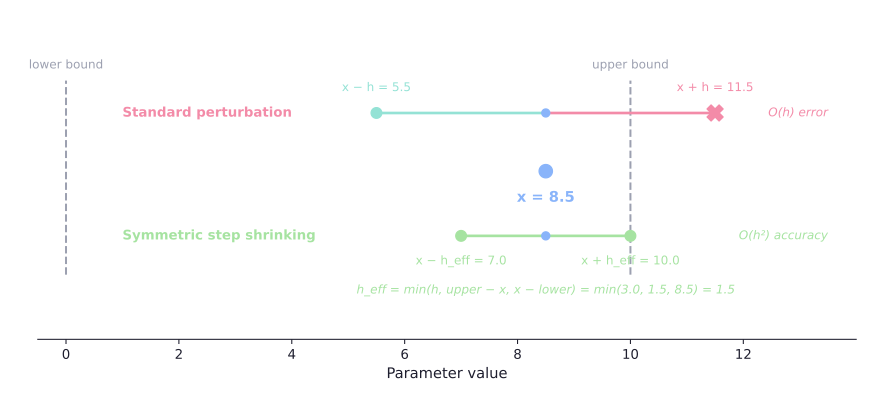
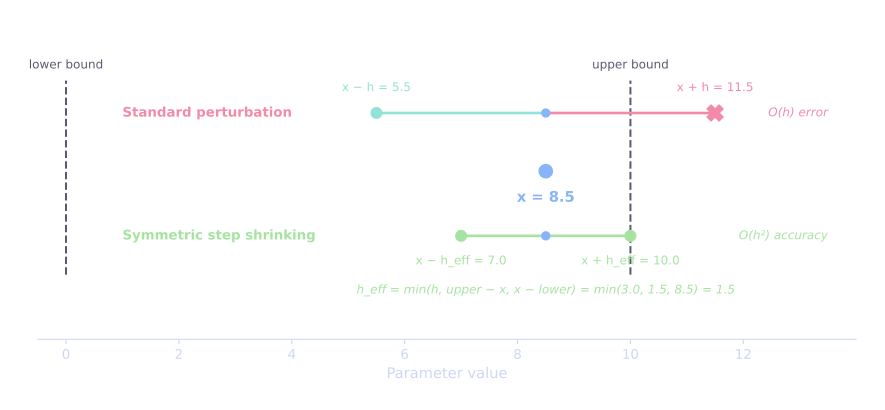
Exception-based fallback (used in q2mm/q2mm): attempt the perturbation, catch the out-of-bounds exception, fall back to one-sided differences. This produces O(h) truncation error instead of central differences' O(h²), giving the optimizer noisy, biased sensitivity information near bounds.
Symmetric step shrinking (used in this repository): compute the effective step size before evaluation:
Both perturbations stay within bounds, preserving O(h²) accuracy.
What happens as a parameter approaches a bound? As x gets closer
to the upper (or lower) bound, h_eff shrinks — the perturbation window
narrows. This has two consequences:
-
Reduced signal-to-noise. Smaller perturbations produce smaller differences in the objective function. The finite-difference gradient and curvature estimates become noisier as they approach the precision floor. However, the estimates remain unbiased (symmetric central difference), unlike the O(h) one-sided fallback.
-
At the bound itself (
h_eff = 0): the parameter is skipped entirely in sensitivity analysis. It receivesd1 = 0andsimp_var = ∞, which excludes it from the simplex refinement phase.
The parameter does not get stuck, though. The gradient-based phase (L-BFGS-B) handles bounds natively using projected gradients — it doesn't rely on our finite-difference step sizes. So even when a parameter sits at a bound, L-BFGS-B can move it away if the gradient points inward. The only effect is that bound-adjacent parameters won't be selected for simplex refinement, which is a mild optimality trade-off rather than a correctness problem.
References
- Seminario, J. M. Int. J. Quantum Chem. 1996, 60, 1271–1277. DOI:10.1002/(SICI)1097-461X(1996)60:7<1271::AID-QUA8>3.0.CO;2-W
- Limé, E.; Norrby, P.-O. J. Comput. Chem. 2014, 36, 244–250 (2015 issue). DOI:10.1002/jcc.23797
- Farrugia, M.; Helquist, P.; Norrby, P.-O.; Wiest, O. J. Chem. Theory Comput. 2025, 22, 469–476. DOI:10.1021/acs.jctc.5c01751
- Norrby, P.-O.; Liljefors, T. J. Comput. Chem. 1998, 19, 1146–1166. DOI:10.1002/(SICI)1096-987X(19980730)19:10<1146::AID-JCC4>3.0.CO;2-M