Architecture
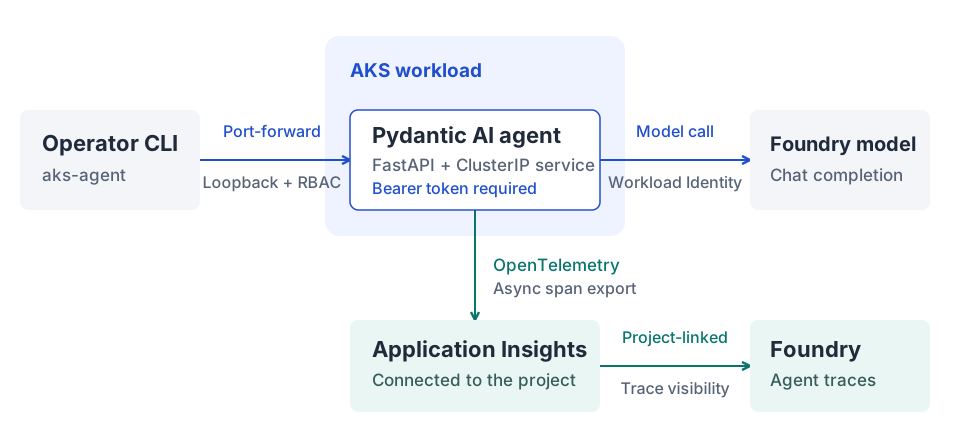
The application request and Foundry observability follow separate paths. Registering the agent does not move execution, change client routing, or make Foundry an invocation proxy.
Request path
- The operator uses the CLI through a loopback-only, Kubernetes-RBAC-authorized port-forward.
- The private ClusterIP service routes to FastAPI.
POST /askrequires a shared bearer token before invoking the agent. - The Pydantic AI runtime makes one chat-completion call, with no tools or retries.
- AKS Workload Identity supplies pod-to-Azure credentials. The Azure OpenAI client targets the approved model deployment using Entra authentication, not a model API key.
The response returns the answer plus trace_id, agent_id, release_id,
pod_name, and pod_namespace. See the response contract.
Telemetry path
The telemetry provider
exports native spans asynchronously to the Foundry project's connected
Application Insights resource. The request-scoped identity processor sets
gen_ai.agent.id, gen_ai.agent.name, and the registered
gen_ai.agent.version on those spans; it does not create a second agent span.
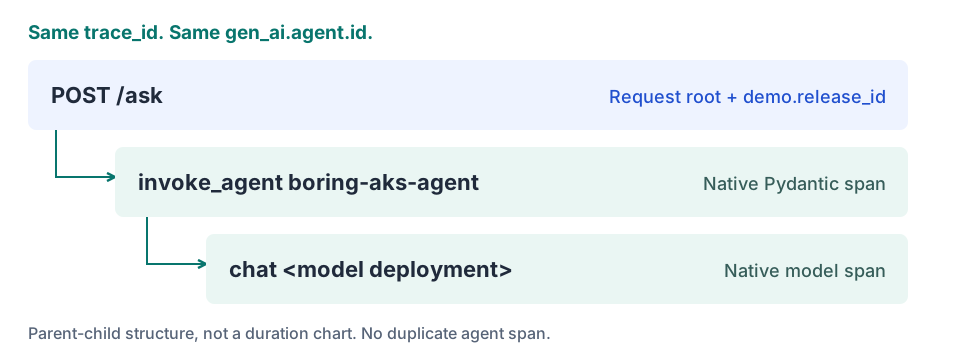
A returned answer proves neither export nor ingestion. Require the matching request in the client output, deployed workload, project-linked Insights, and Foundry's external-agent Traces view. The verification guide defines the required correlation; deployment step 6 provides the procedure.
Foundry's trace evaluation reads the same ingested telemetry through an agent-scoped time window. It does not add a request route or move evaluation execution into the AKS pod. See deployment step 7.
What registration changes
The optional administrative tool
creates or reuses an external-agent record, then reads back its otel_agent_id.
It must match the runtime's OTEL_AGENT_ID. Registration is a separate
administrative action, not a step in each request.
This repository uses Path A, a preview integration. It does not provision a runtime, provide a Foundry Responses invocation endpoint, or imply hosted-agent feature parity. Path B is a different mechanism outside this repository.
Infrastructure is not the request path
The diagram shows runtime relationships, not every provisioned Azure resource. The infrastructure guide covers ACR, the Foundry account/project, monitoring, three separate managed identities, staged RBAC prerequisites, and the AKS-managed node resource group.
Only the application service is private. The AKS API is public and Entra/RBAC-protected; model, registry, and telemetry use public Azure endpoints. There is no private-cluster or Private Link claim. See network boundaries.